Abortion in Japan: Is It Legal, How Much It Costs, and What Foreigners Should Know
Facing an unplanned pregnancy while living in a foreign country can feel overwhelming, especially when you’re uncertain about your legal rights and medical options in Japan.
Abortion in Japan is legal under the Maternal Health Protection Law, with established medical procedures and accessible clinics, particularly in major cities.
This legal framework, updated most recently in 2023 with the approval of medical abortion pills, provides options for women facing difficult reproductive healthcare decisions.
By the end of this article, you will clearly understand Japan’s abortion laws, procedures, costs, and gestational limits.
Is Abortion Legal in Japan? Understanding the Legal Framework and History
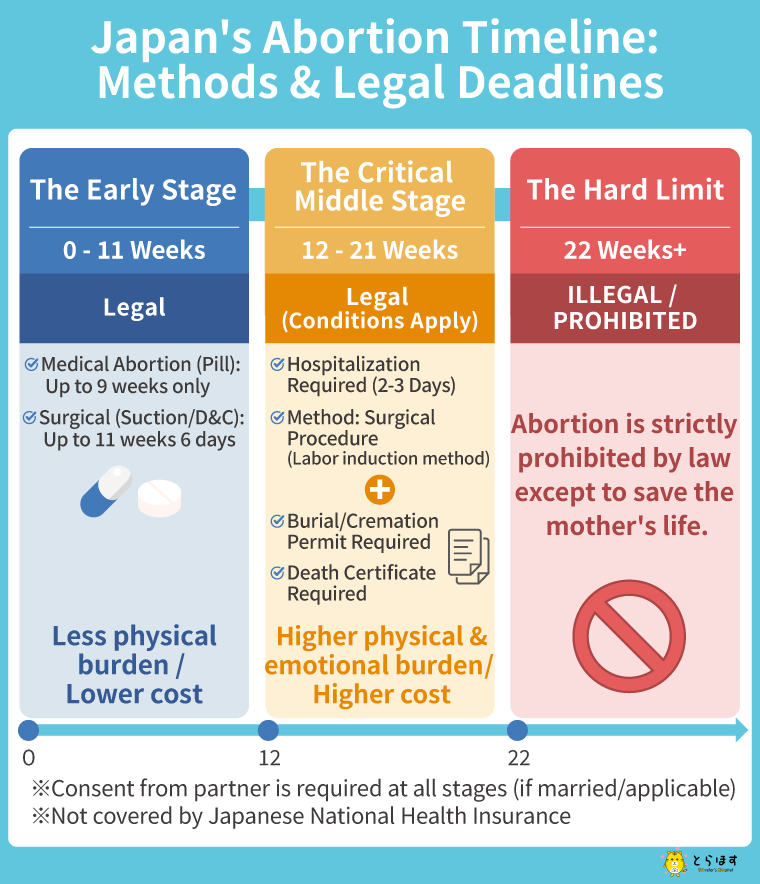
Abortion in Japan is legal under the Maternal Health Protection Law, which permits the procedure up to 21 weeks and 6 days of pregnancy. *Maternal Health Protection Law: e-Gov Legal Database
This legal framework, established in 1996 and based on the earlier Eugenic Protection Law of 1948, defines abortion as “the artificial expulsion of a fetus and its appendages from the mother’s body during a period when the fetus cannot sustain life outside the womb.”
The 22-week limit represents Japan’s legal determination of fetal viability, the statutory point beyond which abortion is prohibited. *NOTE: This article references legal viability (the gestational limit set by law) rather than medical viability (the clinical assessment of when a fetus might survive outside the uterus); many European countries set legal abortion limits at 24 weeks, demonstrating that legal thresholds vary internationally.
Importantly, abortion procedures can only be performed by designated physicians certified by prefectural medical associations.
Abortion Statistics and Current Situation in Japan
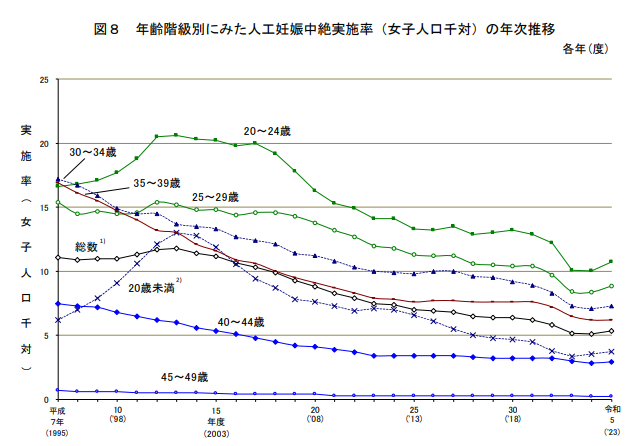
According to the Ministry of Health, Labour and Welfare’s Report on Public Health Administration and Services, approximately 126,734 abortions were reported in FY2022.
Over 99% of the reasons for abortion are due to physical or economic reasons, while less than 0.1% cite sexual assault as the reason.
Critical Requirements of Abortion for Foreigners
Foreign residents in Japan must understand three critical legal and administrative requirements that may differ significantly from their home countries:
Understanding these requirements from the outset is essential for making informed decisions and avoiding situations where options become limited or unavailable.
The following sections explain each requirement in detail and how they specifically affect foreign residents.
Spousal Consent Requirement
Under the Maternal Health Protection Law, spousal consent is generally required for married women seeking an abortion.
However, exceptions apply in cases where the spouse is deceased, cannot be located, or is unable to express consent.
In cases of domestic violence or when obtaining spousal consent poses a risk to the woman’s safety, physicians may proceed without it, in accordance with guidelines issued by the Ministry of Health, Labour and Welfare. *Maternal Health “Act Article 14”
Although the law does not require partner consent for unmarried women, many clinics request a partner’s signature as part of their own internal consent procedures.
This is a clinic-level practice, not a legal requirement. If obtaining a partner’s signature is not possible, discuss alternative options directly with the clinic.
For foreign women whose spouses are in their home countries, obtaining consent may involve international mail, notarization, and time delays that could push them closer to the gestational limit.
Gestational Time Limit: 21 Weeks 6 Days
The absolute legal limit for abortion in Japan is 21 weeks and 6 days of pregnancy (effectively just before 22 weeks), calculated from the first day of the last menstrual period, and exceeding this limit makes abortion impossible except in extremely rare cases where the mother’s life is in immediate danger.
Abortions after 12 weeks are classified as “mid-term abortions”, and require a fundamentally different approach—physicians must artificially induce labor using medications to trigger uterine contractions, effectively causing a medically-induced stillbirth rather than a surgical removal procedure.
This mid-term process mandates filing a fetal death certificate with municipal authorities, along with arrangements for cremation or burial.
Because of these substantial differences in procedure, physical burden, and psychological impact,,many physicians decline to perform abortions after 12 weeks due to increased medical risks and complexity.
No Insurance Coverage
Abortion in Japan is not covered by any insurance system, including Japanese national health insurance.
Travel insurance policies also exclude abortion coverage, categorizing it as a “planned medical procedure” or “preventable condition” rather than an emergency medical need, even in cases of contraceptive failure or sexual assault.
The lack of insurance coverage means foreign women must prepare to pay the full cost out of pocket.
Costs vary significantly by gestational age—see the cost breakdown below for details.
Types of Abortion in Japan and Their Costs
Abortion in Japan is performed through two legally recognized methods:
Both methods require out-of-pocket payment as they are not covered by Japanese national health insurance. Costs range from approximately ¥100,000 for early-stage procedures to ¥600,000 for later-stage procedures requiring hospitalization.
Understanding the practical differences between these methods—including availability, procedural steps, and restrictions specific to foreign residents—is essential for informed decision-making.
Surgical Abortion
Surgical abortion is the traditional and most widely available method in Japan.
This method involves a physician performing a medical procedure to remove pregnancy tissue from the uterus, typically using vacuum aspiration or dilation and curettage (D&C).
Procedure
・Vacuum aspiration ・D&C (Dilation & Curettage)
Gestational limit
Up to 12 weeks; 12-21 weeks requires
Advantages
• Short procedure time (10-15 minutes) • High success rate with clear completion • Performed under direct medical supervision
Disadvantages
• Invasive procedure • Requires anesthesia (local or general) • Potential psychological impact for some patients
Under Japanese law, abortions performed after 12 weeks require hospitalization and involve additional administrative procedures.
These include filing a stillbirth notification (死産届) with the local municipal office and obtaining a cremation or burial permit.
These requirements often surprise foreign residents unfamiliar with Japanese regulations.
Early medical consultation is strongly recommended to fully understand the procedural, financial, and administrative implications.
As with any medical procedure, abortion may involve risks including bleeding, infection, and incomplete procedure requiring additional treatment.
Serious complications are rare when performed by designated physicians (指定医師) at approved medical facilities.
If you experience heavy bleeding, high fever, or severe abdominal pain after the procedure, seek immediate medical attention.
Estimated Abortion Costs by Gestational Age
Gestational Age
Method
Estimated Cost
Up to 9 weeks
Surgical or Medical (pill)
¥100,000–¥150,000
10–11 weeks
Surgical
¥120,000–¥200,000
12–21 weeks
Surgical (hospitalization required)
¥300,000–¥600,000
The above figures are approximate estimates based on publicly available clinic pricing in the Tokyo metropolitan area.
Actual costs vary by clinic, region, facility type, and individual circumstances.
All abortion procedures are out-of-pocket as they are not covered by public health insurance.
Medical Abortion Pills
Medical abortion using pharmaceutical pills became available in Japan following the approval of “Mefeego Pack” (mifepristone and misoprostol) by the Ministry of Health, Labour and Welfare in April 2023.
This was the first oral abortion medication approved in Japan.
Procedure
Medication-based method under physician management *Home Use Prohibited
Gestational limit
Up to 9 weeks only
Advantages
• No surgical intervention required
Disadvantages
• Bleeding and cramping possible • Completion takes several days
Cost range
¥100,000-¥150,000 *Not covered by public health insurance
Japan requires both medication doses to be administered and monitored at a medical facility—patients cannot take pills home.
Abortion Process Looks Like in Practice
The abortion process in Japan requires typically involves three clinic visits over a period of several weeks, including consultation, consent documentation, the procedure, and follow-up.
This timeline may make it extremely difficult for tourists or short-term visitors to access abortion services within a short stay.
Typical Abortion Process Timeline:
Initial Consultation (Week 1)
Consent Form Preparation (1-7 days)
Procedure Day (Week 2-3)
Post-Procedure Follow-Up (1-2 weeks later)
Important: Traveling to Japan for the specific purpose of obtaining an abortion is not recommended and is generally not supported by medical facilities.
For foreign residents already living in Japan with valid long-term visas, early consultation is essential due to the strict 21-week-6-day legal limit and the 2-4 week process timeline.
Making an Informed Decision About Abortion in Japan
Abortion in Japan is legal for up to 21 weeks and 6 days under the Maternal Health Protection Law.
If you are a foreign resident facing an unplanned pregnancy in Japan, early consultation with a designated physician is essential due to strict time limits
Understanding your legal rights, available methods, and procedural requirements empowers you to make safe, informed reproductive healthcare decisions.